Three years and two months. That’s the average lifespan of a car battery in a temperate climate, and just about every driver finds out the hard way. You turn the key, hear a slow mechanical groan, and the dashboard lights flicker like a dying flashlight. The battery in your Cadillac is the one part you never think about until it strands you.
Here’s the good news: batteries usually telegraph their death weeks in advance. The warning signs are quiet, but they’re there. Knowing what to look for can mean the difference between a five-minute stop and a 45-minute wait on the shoulder of Highway 1. Drivers who want a proper diagnosis rather than a parking lot jump start often choose a Cadillac battery replacement service that tests the whole charging system, not just the single cell under the hood.
This guide covers why batteries fail, the signals most drivers skip past, and a simple decision framework for jump-starting versus replacing. You’ll walk away knowing exactly what your car is telling you.
Why car batteries die even when nothing seems wrong
Your battery lives a hard life it never signed up for. It has two jobs: crank the starter on a cold morning and absorb every electrical hiccup the car throws at it. Heat does more damage than cold, which surprises most people. Summer temperatures inside an engine bay can climb well past the ambient air outside, and that sustained heat slowly evaporates the electrolyte and corrodes the internal plates.
According to baseline climate data from the National Weather Service, coastal zones see wide swings between cool nights and warm afternoons, and that daily expansion and contraction adds wear a garage-kept car in a stable climate never sees. If your car sits outside near the coast, expect a shorter battery life than the sticker suggests.
Short trips are the silent killer. A five-minute drive to the coffee shop never lets the alternator fully recharge what the starter pulled out. Do that twenty times a week and you’re slowly draining the battery while convincing yourself everything’s fine.
Parasitic draw is the other culprit. Even with the engine off, modern Cadillac models pull current to remember your seat position, run the keyless entry receiver, and keep the onboard computer half awake. If a module stays awake after shutdown, it drains the battery overnight. I’ve watched a healthy-looking battery test fine at noon and die by 8 a.m. because a door sensor never told the car to sleep. A real test catches that. A jump start just hides it.
The warning signs most drivers miss
You know the obvious one: the slow crank. But there are four quieter tells that show up before the starter ever struggles.
- Dim headlights that brighten when you rev the engine. That’s a charging system signal, not just an old bulb.
- A battery light that flickers on rough roads. A loose terminal or a failing alternator connection, and both stress the battery.
- Dashboard clocks and radio presets resetting. The battery is dropping voltage below the threshold the memory modules need.
- A faint rotten-egg smell. Sulfur coming from an overcharged or overheating battery is a real safety issue, so get it checked that day.
I’d add a fifth that most lists skip: a battery that’s physically swollen or bulging on the case. That means it’s been cooking, usually from a charging system problem. Replace it, don’t top it off.
Is your battery actually the problem?
Here’s where people waste money. A dead battery is often a symptom, not the disease. The alternator charges it, the starter draws from it, and a failing connection anywhere in that chain mimics a bad battery. Put a fresh battery on a car with a weak alternator and you’ll be back on that shoulder in six months, angrier than the first time.
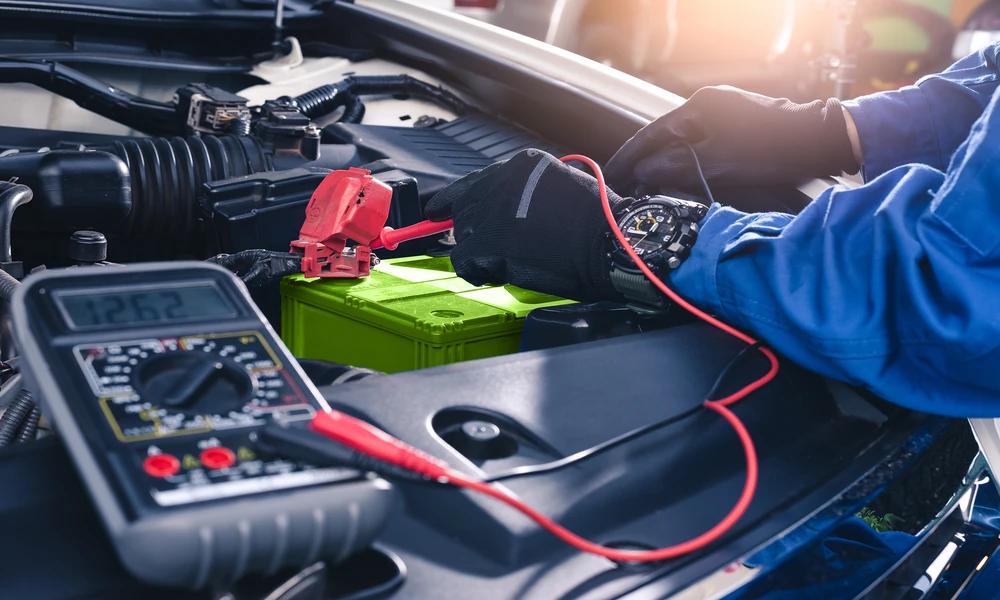
This is where a proper service beats a parts store swap. A technician tests the battery under load, checks the alternator’s output, and inspects the terminals for corrosion. According to the U.S. Department of Energy, automotive electrical systems have grown more demanding as vehicles add electronics, which means the charging system carries more load than it did a generation ago. Those extra systems make a weak alternator far easier to miss on a short test.
| Symptom | Likely cause | What to do |
|---|---|---|
| Slow crank when cold | Battery losing cranking amps | Load test, then decide on replacement |
| Lights dim at idle | Alternator or charging circuit | Test charging output before replacing battery |
| Dead overnight, fine after jump | Parasitic draw or a module staying awake | Diagnostic draw test, not a new battery |
| Swollen case or sulfur smell | Overcharging or internal failure | Replace now and inspect the charging system |
Jump it or replace it? A quick decision framework
I use a simple three-question rule, and you can borrow it.
One: how old is the battery? If it’s past the four-year mark, replace it. Jump-starting a four-year-old battery is renting time from a problem you’ll face again soon. Two: did it die after a short trip or after sitting for weeks? After a short trip points to charging trouble. After weeks of sitting points to a draw or a drained battery that never got a full recharge. Three: does the crank feel weak even after the jump? That’s a failing battery or a charging fault, and it needs a real diagnosis.
Here’s the part that saves you the most grief. A jump start only buys you enough charge to restart the engine. It doesn’t recharge a deeply drained battery. If your battery spent the week at half charge, driving around town won’t fix it. You need a proper charge cycle or a replacement, and that’s exactly what a certified service checks before handing you the keys.
If you’re running a business with vehicles on the road, downtime costs real money. Labor data from the Bureau of Labor Statistics shows that automotive technicians are among the largest skilled trade groups in the country, which means qualified diagnosis is widely available and worth using. For a fleet, a scheduled battery check beats an unplanned roadside call almost every time.
What to do this week, before it strands you
Pop the hood and look at your battery’s date sticker. If it’s within a year of its average lifespan, book a test now rather than waiting for the slow crank. Check the terminals for white or green crust, which is corrosion eating your connection. And keep a set of jumper cables in the trunk regardless of battery age, because the car next to you may need them more than you do.
Batteries are the cheapest part to replace and the most annoying to ignore. A slow crank today is a no-start tomorrow.
So here’s my question for you: when did you last think about the battery under your hood, and do you know what it would tell you if you looked? Get it tested before it answers for you.